My goals for the Meteorology 1010 class are to learn more about our atmosphere and the Earth's weather. I want to be able to share this knowledge with my high school students.
Short-Term Goals
My short term goals for my Salt Lake Community College experience are to complete this Meteorology 1010 class with an A grade. This will finish up the endorsement classes that I have to complete to teach high school Earth Systems.
Long-Term Goals
My long term goals are to have a better understanding of weather and the atmosphere. I really enjoy weather and weather related issues. I teach two units on the Atmosphere and Meteorology. I hope to revise these units after taking the Met 1010 class. I would like to be able to integrate more hands-on learning experiences for my high school students. My goal is that my classroom learning experiences will open up some new ideas and lesson plans for my high school students.
SLCCs Learning Outcomes
Here are some examples of my work and how I am meeting SLCC's learning outcome goals.
1. Students communicate effectively. This includes developing critical literacies—reading, writing, speaking, listening,
visual understanding—that they can apply in various contexts; Organizing and presenting ideas and information
visually, orally, and in writing according to standard usage; Understanding and using the elements of effective
communication in interpersonal, small group, and mass settings.
Meteorology 1010 - Assignment 1 Water Issues - has a learning outcome for students to learn about the difference that WaterAid is making by educating and assisting the poorest people on the planet on how to obtain, use and acreate a plan for clean water and sanitary water practices. The water issues assignment was for us to watch five short videos and summarize them. This is an effective way to communicate a lot of different ideas in a short amount of time. As students we were able to see the people that WaterAid was helping and to see the conditions that they live in. As a high school science teacher, I often wrap up units with a video or start a lesson with a short video clip. Today's students are very visual learners. I like to hook them to the new unit with a highly interesting clip that piques their imagination. At the end of the unit (a unit usually lasts a couple of weeks), I like to cement everything together with a very informative and relevant video, usually from NOVA, BBC, PBS or National Geographic. I have a link to my Water Issues essay and responses on the Coursework page.
This includes approaching practical problems by choosing and applying appropriate mathematical techniques; Using information2. Students develop quantitative literacies necessary for their chosen field of study.
represented as data, graphs, tables, and schematics in a variety of disciplines; Applying mathematical theory, concepts,
and methods of inquiry appropriate to program-specific problems.
I really like the Prentice Hall, The Atmosphere textbook that we are using and the online GEODe audio visual supplementation adds much to the learning experience. The book presents information and data effectively in the form of graphs, tables and other schema that make the learning objectives comprehensible. I have a Master's degree in chemistry so I am very familiar with this form of analytical communication. One of my goals as a teacher is to implement more graphs and tables into my high school science classes. This class is helping me to see some effective ways to introduce more quantitative litteracy into my classes.
3. Students think critically and creatively.
This includes reasoning effectively from available evidence; demonstratingeffective problem solving; engaging in creative thinking, expression, and application; Engaging in reflective thinking and
expression; Demonstrating higher-order skills such as analysis, synthesis, and evaluation; Making connections across
disciplines; Applying scientific methods to the inquiry process.
One of my foremost goals for my college experience is to develop greater understanding for the sciences that I teach at the high school. Everyday I encourage students to solve problems, make connections, use the scientific method and use higher order thinking skills. In order to effectively communicate critical thinking, I have to constantly be engaged in this level of inquiry myself. I am constantly searching for the latest research on whatever topic I am introducing. I try to make lesson plans that go beyond just learning the material and take it to the analysis and synthesis of the topic of study. This is one of my top goals for this year. All of the Utah State testing is based on students learning higher order thinking skills. I hope to translate all of these connections to my students.
4. Students develop the knowledge and skills to be civically engaged.
This includes understanding the natural,political, historical, social, and economic underpinnings of the local, national, and global communities to which they
belong; Developing the awareness of both civil rights and civil responsibilities for individual and collective action in a
democracy; Engaging in service-learning for community building and an enhanced academic experience; Develop the
knowledge and skills to take leadership roles.
My ultimate goal as a high school teacher is to develop civically minded citizens that will be able to think through the local, national, and global issues and make well-informed decisions. Our way of life and future depends on this. Assignment 1 was very effective in communicating a very real global need and how the organization, WaterAid, is educating and helping people all over the world with their water needs. I have recently had the opportunity to interface our high school students with a real life science project in Kanab. The project was started by Dr. Kevin Shurtleff and he has developed a techniligy that converts algae to biofuels. This technology is important in meeting our current worldwide energy demands with a process that is renewable and is turning waste (sewage ponds) to fuel. I have five students that will be sorking through the summer on this project. This will give the students a real life science experience that will prepare then for their futures. All work is volunteer and the students have caught on to the "let's do what we can to change the world" attitude!
5. Students develop the knowledge and skills to work with others in a professional and constructive
manner.
This includes engaging with a diverse set of others to produce professional work; Interacting competentlyacross cultures; understanding and appreciating human differences; Understanding and acting on standards of
professionalism and civility, including the SLCC Student Code of Conduct.
My whole student experience has prepared me to work with my co-teachers, adminstration and other professional people in a professional way. I interact with education professionals on a daily basis. Every year I work closely with many other teachers to develop cross curriculum assignments that will help students to bridge begtween science and english or science and word processing, or science and math. I also have local professionals talk to my classes several times a year. typically about six a year. I also set up three fieldtrips a year to the surrounding national parks (Grand Canyon, Zion and Bryce) and a trip to the Glen Canyon Dam. I work with many different kinds of professional people at many different levels to make all of these trips work. Everything from the bus drivers to the rangers and educational specialists. My class work at SLCC has put me in contact with a variety of instructors and they have all been very professional and helpful in my coursework experience.
6. Students develop computer and information literacy.
This includes using contemporary computer hardwareand software to effectively complete college-level assignments; Gathering and analyzing information using technology,
library resources, and other modalities; Understanding and acting upon ethical and security principles with respect to
computer technology and to information acquisition and distribution; distinguishing between credible and non-credible
sources of information, and using the former in their work in an appropriately documented fashion.
The classes that I have taken at SLCC have all been either online classes or streaming. Both class formats require extensive use of the computer. I had to submit all assignments using the Canvas online platform. ALso, all tests and quizzes were taken online. Every class also required me to interface with other students in the class. I usuallly had to respond to one of their posts or e-mail them with questions about an assignment. Most of the assignments that I have turned in have required extensive research on the Internet. I have written several papers where I have had to use credible Internet sources and document those sources. I have attached a file from a paper on a prereading assignment that I submitted to the University of Phoenix entited Prereading Strategy Project. pdf
7. Students develop the attitudes and skills for lifelong wellness.
This includes understanding the importance of physical activity and its connection to lifelong wellness; learning how participation in a fitness,sport or leisure activity results in daily benefits including stress reduction, endorphin release, and a sense of wellbeing.
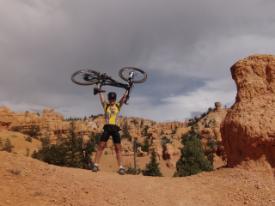
I have always been a strong believer in the importance of physical fitness. I played many sports thoughout my life. As early as fourth grade I was playing basketball. In middle school I was awarded the all sports trophy for playing basketball, softball, volleyball and track. Our volleyball team was undefeated for two years in a row. In high school, I stuck to volleyball and we took state (Nevada) two years in a row. I continued to play volleyball through college and after college, I played on a city league team. At the age of 18 I started bicycle riding very seriously and I continue to be a pretty serious cyclist now at the age of 50. I enjoy all forms of cycling - road, mountian, loaded cross country touring and I teach a spin cycling class three days a week. I have taught this class for our local fitness center for 5.5 years. I also enjoy hiking and weightlifting. In the past I have devoted a lot of time to rock climbing and raquetball, but my shoulder will not allow me to partake in those activities at this time in my life. That is the great benefit of cycling; you can do it all of your life!

|
Prereading Strategy Project.pdf Size : 157.681 Kb Type : pdf |
